
Resources · Amsler grid
Free printable Amsler grid
A quick home check for changes in your central vision. If lines look wavy, blurry or missing and that’s new, call your eye doctor right away, the same day if you can.
Created by Spencer Fuller, MD, MPH, board-certified retina surgeon · Updated
How do I use an Amsler grid?
- Wear your reading glasses.
- Hold the grid about 12 inches (30 cm) away, in good light.
- Cover one eye and look at the center dot. Keep looking at the dot.
- Notice if any lines look wavy, blurry or missing.
- Do the other eye, and compare with how the grid usually looks.
Use the same glasses, light and distance each time, so a change really is a change.
If anything is new, call your eye doctor right away, the same day if you can. Note which eye and where on the grid.
Get seen today for a sudden curtain or shadow, a shower of new floaters or flashes, or sudden vision loss.
Free, no email needed. Print at 100% so the grid stays true size.
Look at the center dot · one eye at a time · about 12 inches from the screen
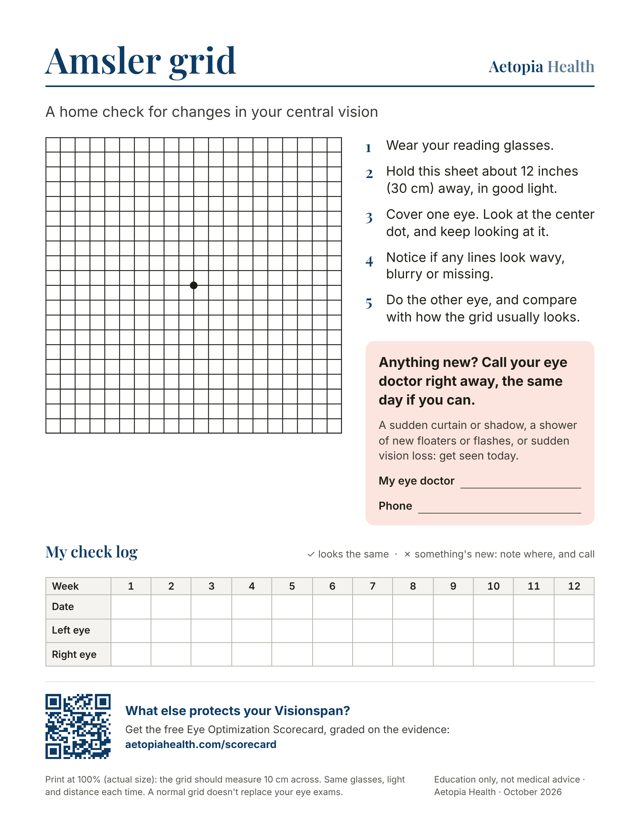
Print it for the fridge
One page you can keep where you’ll see it.
- A true-size grid, 10 cm square
- The five steps, in large type
- A spot for your eye doctor’s phone number
- A 12-week check log for each eye
Questions people ask
What do wavy lines on an Amsler grid mean?
New wavy or bent lines can mean fluid under the macula, the center of your retina. The most common cause is wet macular degeneration. It’s very treatable when it’s caught early, which is why you call right away. Wavy lines can also come from other eye problems, like a wrinkle on the retina or diabetes-related swelling, so your eye doctor needs to check.1,6,7
Who should use an Amsler grid?
People with macular degeneration or a family history of it, and anyone whose eye doctor has asked them to check at home. It’s also an easy check for anyone curious about their central vision.1
How often should I check?
Most people with macular degeneration check daily or weekly. Go with whatever your eye doctor recommends.1
Can I use the grid on my phone or computer?
Yes, for a quick check. Make the grid fill the screen and hold it at the same distance each time, about 12 inches. Paper is better because the squares stay the right size.2
Does a normal grid mean my eyes are fine?
Not completely. It only checks your central vision, and it can miss some changes, so keep your regular eye exams.3
How accurate is the Amsler grid?
It’s a helpful alarm, not a diagnosis. In a 2023 review, it caught about two out of three cases of wet macular degeneration and also gave some false alarms. So a normal or an abnormal result never replaces an eye exam.3,4,5
Is there a more sensitive home test?
For some people, yes. Home monitors like ForeseeHome, which a retina specialist can prescribe for people with intermediate macular degeneration, caught wet macular degeneration earlier than usual care in a large trial. It’s a prescription device, it works best when you use it regularly, and it adds to your scheduled eye exams rather than replacing them. Ask your eye doctor whether you’re a candidate.8,9
References
How to use the grid
- Vemulakonda GA, et al. Age-Related Macular Degeneration Preferred Practice Pattern. Ophthalmology. 2025;132(4):P1–P74. doi:10.1016/j.ophtha.2024.12.018
- Amsler M. Earliest symptoms of diseases of the macula. Br J Ophthalmol. 1953;37:521–537.
How accurate it is
- Bjerager J, et al. Diagnostic accuracy of the Amsler grid test for detecting neovascular age-related macular degeneration: a systematic review and meta-analysis. JAMA Ophthalmol. 2023;141(4):315–323. doi:10.1001/jamaophthalmol.2022.6396
- Crossland M, Rubin G. The Amsler chart: absence of evidence is not evidence of absence. Br J Ophthalmol. 2007;91(3):391–393. doi:10.1136/bjo.2006.095315
- Estreicher A, et al. The Amsler grid in everyday practice: a review of its role and limitations in primary care. Clin Ophthalmol. 2026;20. doi:10.2147/OPTH.S542357
What wavy lines can mean
- Apte RS. Age-related macular degeneration. N Engl J Med. 2021;385(6):539–547. doi:10.1056/NEJMcp2102061
- Wang H, et al. Validation of a novel functional test for assessing metamorphopsia using epiretinal membranes as a model. Sci Rep. 2020;10:14938. doi:10.1038/s41598-020-71627-1
Home monitoring beyond the grid
- AREDS2-HOME Study Research Group; Chew EY, Clemons TE, et al. Randomized trial of a home monitoring system for early detection of choroidal neovascularization: Home Monitoring of the Eye (HOME) study. Ophthalmology. 2014;121(2):535–544. doi:10.1016/j.ophtha.2013.10.027
- Hogg RE, Sivaprasad S, Wickens R, et al. Home-monitoring vision tests to detect active neovascular age-related macular degeneration. JAMA Ophthalmol. 2024;142(6):512–520. doi:10.1001/jamaophthalmol.2024.0918
This page is for general education only and is not medical advice. A sudden curtain or shadow, a shower of new floaters or flashes, or sudden vision loss needs eye care the same day.
What else protects your Visionspan™?
The Amsler grid is one piece of the picture. The free Eye Optimization Scorecard looks at the everyday habits that help your eyes keep working well for you, with a few simple ideas to try for each one.