
When a 25-year-old sits in my exam chair and I look at their retina, I can often see their childhood written back there: how much that eye grew, how much the tissue stretched.
Most of these patients have no idea. As far as they know, they're nearsighted, they wear glasses, and that's the whole story. Their parents usually don't know either. But a glasses prescription at age eight is just the beginning, and a big part of what drives it is something parents shape every day.
The short version: Nearsightedness (myopia) usually means the eye has grown too long. Long stretches of up-close focus, on screens or books, especially indoors, are linked to it, and time outdoors in daylight is the habit with the strongest evidence for preventing it. Aim for about two hours outside a day, get your child's eyes checked early, and if nearsightedness is getting worse, ask a pediatric eye doctor about myopia control.
What is nearsightedness?
Nearsightedness usually means the eyeball has grown too long, so light focuses in front of the retina instead of on it. Glasses move the focus back onto the retina, but they don't change the length of the eye.
From the outside, a nearsighted eye looks completely normal. The difference is inside. During childhood, the eye tunes its own growth, using where light lands on the retina as its guide. Long stretches of up-close focus, especially indoors in dim light, push it to grow longer. Bright outdoor light seems to push the other way.
We call that growth axial elongation, and here's how I explain it to families. The retina is like wallpaper on the inside wall of the eye. Stretch the wall a little and you won't notice the pattern change. Stretch it a lot and the pattern distorts, and eventually the paper starts to thin and tear. That's one of the ways very nearsighted people end up with weak spots and tears in their retina. Those changes are structural. Glasses can't undo them.
Does screen time cause nearsightedness in kids?
Screen time is linked to nearsightedness, but screens aren't the only culprit. The bigger pattern is long stretches of up-close focus indoors, whether that's a tablet or a book.
The best summary we have is a 2025 review that pooled 45 studies and more than 300,000 people. In children averaging about nine years old, each additional daily hour of screen time was associated with about 21% higher odds of nearsightedness. The pattern wasn't a straight line: the effect was small at about an hour a day, climbed until the odds roughly doubled at about four hours a day, and kept rising more slowly after that.
Two caveats. First, these studies show an association, not proof that screens alone cause it. Second, screen time usually means indoor time and up-close time, and it's hard to separate the three. A 2026 study from Singapore found paper-based reading and writing carried a similar risk, about 20% higher odds per daily hour. So I wouldn't worry much about whether your child is doing homework or watching a show. What matters is long, unbroken stretches up close, especially when they aren't balanced with time outside.
One thing I've noticed as a parent: kids put books down. They read for a while, wander off, come back. Tablets are different. Kids tend to stay glued to them until someone takes them away. The research can't separate those two yet, but I think the breaks matter.
Why does a retina surgeon care about a glasses prescription?
Because a longer eye stays longer for life, and it carries higher risks of retinal detachment, myopic degeneration, glaucoma, and cataract decades later.
Compared with someone who isn't nearsighted, the odds of a retinal detachment are about 3 times higher with mild nearsightedness, about 9 times higher with moderate, and about 12 times higher with high nearsightedness.
Then there's myopic degeneration, a slow thinning of the layers under the retina that can show up in a person's 40s, 50s, and beyond. When it reaches the macula, the center of the retina, it can cause permanent distortion and vision loss, and sometimes abnormal blood vessels that need injections in the eye. It affects about 2% of people worldwide, and each extra millimeter of eye length roughly triples the odds. In one 10-year study, about a third of people with it got worse over that decade.
However, the research suggests that every step counts. Keeping a child's prescription even one step lower can reduce the long-term risk of these complications.
I've operated on children's retinas. It's hard on the child and the whole family: missed school, sometimes more than one surgery, and months to years before things settle. The retina is essentially brain tissue, and once it's scarred it doesn't always work the way it should. Those kids and families have stayed with me.
I'm also a father of four, so I get it. Screen time is a personal decision, and sometimes kids just need to be entertained. No judgment from me. The goal is to know where your effort counts most.
What can parents do to protect their kids' eyes?
Get your child outside about two hours a day, break up long stretches of up-close focus, get their eyes checked early, and ask about myopia control if their prescription is changing.
Time outdoors (the strongest evidence)
In randomized school trials, about 31% of children in schools that added outdoor time became nearsighted over three years, compared with about 40% in schools that didn't. The research doesn't pin down one perfect number, but about two hours a day is a good goal.
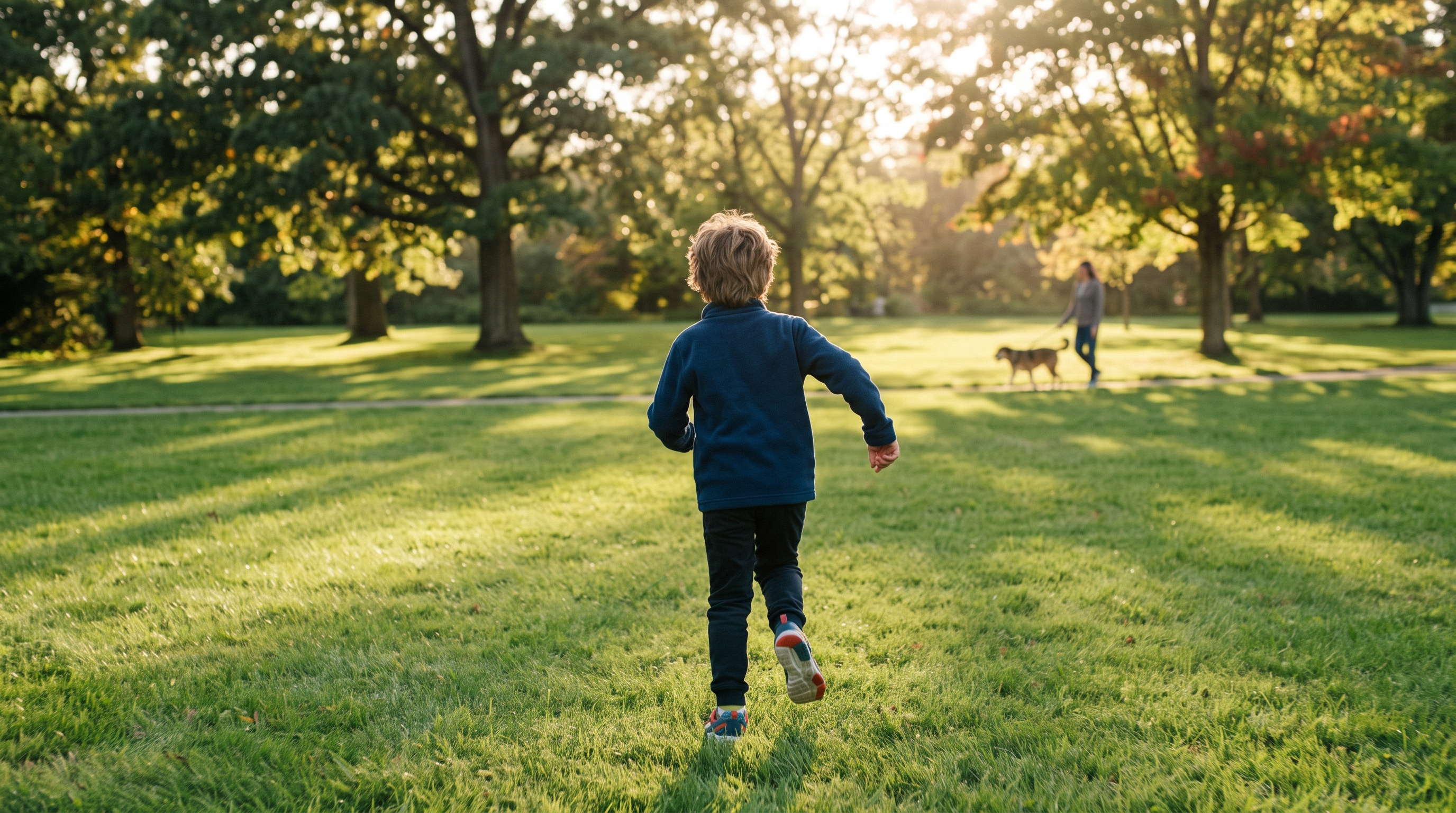
It doesn't have to be one block. Recess counts, walking the dog counts, soccer practice counts, yard work counts, family walks count. And please don't tell your child to look at the sun; they just need to be outside in daylight.
Outdoor time works best at keeping nearsightedness from starting. Once it has started, it slows progression less, so keep the outdoor time and add the steps below.
The 20-20-20 habit
Every 20 minutes, look at something 20 feet away for 20 seconds. Honestly, the evidence that this prevents or slows nearsightedness isn't strong. It's still a good lifelong habit, it reduces strain, and it builds in the breaks that tablets tend to remove.
Early eye exams
Make sure your child's eyes are checked in the first few years of life and regularly after that. School screenings help, but they don't replace an exam. The sooner a prescription is caught, the better the chance of clear vision in both eyes and good depth perception.
Other approaches
If your child's nearsightedness is progressing, ask a pediatric ophthalmologist or optometrist who does myopia management about the options:
Low-dose atropine eye drops
Myopia-control soft contact lenses
Overnight cornea-reshaping lenses (Ortho-K)
None of them make myopia disappear, and they don't all work the same way or to the same degree. Glasses are still essential for clear vision; these treatments aim to slow how fast the eye keeps growing.
Do blue light glasses help prevent myopia?
No. Blue light glasses aren't a myopia treatment, and the best review of blue-light-filtering lenses (in adults) found little evidence they help.
They're heavily marketed, and I understand why parents buy them. But a child who is becoming nearsighted needs an eye exam and more time in outdoor light, not blue light glasses.
The free Eye Optimization Scorecard
Habits like this one are what my free Eye Optimization Scorecard is about: the everyday foundations that help protect your eyes, with a few simple ideas to try for each one.
Quick answers to common questions
Does screen time cause myopia in kids?
It's linked to it. Each extra daily hour of screen time is associated with about 21% higher odds of nearsightedness, but up-close reading and time indoors matter too. Time outdoors is the strongest protective habit.
How much outdoor time do kids need to help prevent myopia?
About two hours a day is a good goal, and it can be split up: recess, sports, walks, and play all count.
Can myopia in children be reversed?
Not with current treatments. Glasses correct the blur, and treatments like low-dose atropine, myopia-control contact lenses, and Ortho-K can slow progression, but none shorten an eye that has already grown.
Why does nearsightedness raise the risk of retinal detachment?
A nearsighted eye is usually longer, which stretches and thins the retina. The odds of retinal detachment are about 3 times higher with mild, 9 times with moderate, and 12 times with high nearsightedness.
Do blue light glasses prevent myopia?
No. They aren't a myopia treatment. A child who is becoming nearsighted needs an eye exam and more time outdoors.
References
Screen time and near work
1. Ha A, et al. Digital screen time and myopia: dose-response meta-analysis. JAMA Netw Open. 2025;8(2):e2460026. PMID 39982728.
2. Wu F, et al. Reading, writing and screen time with myopia: GUSTO. Acta Ophthalmol. 2026;104(3):e337–e345. PMID 41035125.
3. Huang HM, Chang DS, Wu PC. Near work and myopia meta-analysis. PLoS One. 2015;10(10):e0140419. PMID 26485393.
4. Enthoven CA, et al. Computer use and myopia: Generation R. Prev Med. 2020. PMID 31954142.
Complications of myopia
5. Haarman AEG, et al. The complications of myopia. Invest Ophthalmol Vis Sci. 2020;61(4):49. PMID 32347918.
6. Zou M, et al. Prevalence of myopic macular degeneration worldwide. Br J Ophthalmol. 2020;104(12):1748–1754. PMID 32188679.
7. Hashimoto S, et al. Axial length and myopic maculopathy: the Hisayama Study. Ophthalmol Retina. 2019;3(10):867–873. PMID 31202664.
8. Yan YN, et al. Ten-year progression of myopic maculopathy: Beijing Eye Study. Ophthalmology. 2018;125(8):1253–1263. PMID 29602569.
9. Tideman JW, et al. Axial length and risk of uncorrectable visual impairment. JAMA Ophthalmol. 2016;134(12):1355–1363.
10. Loughman J, Bullimore MA, Flitcroft DI. Myopia and eye disease: from correlation to causation. Prog Retin Eye Res. 2026;114:101497. PMID 42480650.
Prevention and treatment
11. Kido A, et al. Interventions to increase time outdoors for myopia. Cochrane Database Syst Rev. 2024. PMID 38864362.
12. Lawrenson JG, et al. Interventions for myopia control in children. Cochrane Database Syst Rev. 2025. CD014758.pub3.
13. Singh S, et al. Blue-light filtering spectacle lenses in adults. Cochrane Database Syst Rev. 2023. CD013244.pub2.
14. Jacobs DS, et al. Refractive Errors Preferred Practice Pattern. Ophthalmology. 2023;130(3):P1–P60.
15. Muth ND, et al. Role of the pediatrician in healthy, active living. Pediatrics. 2024;153(3):e2023065480.
This article is for general education only and is not medical advice for you or your child. If you have questions about your child's eyes, see a pediatric ophthalmologist or optometrist. Sudden vision changes, flashes, a shower of new floaters, or a curtain over your vision need eye care right away.