
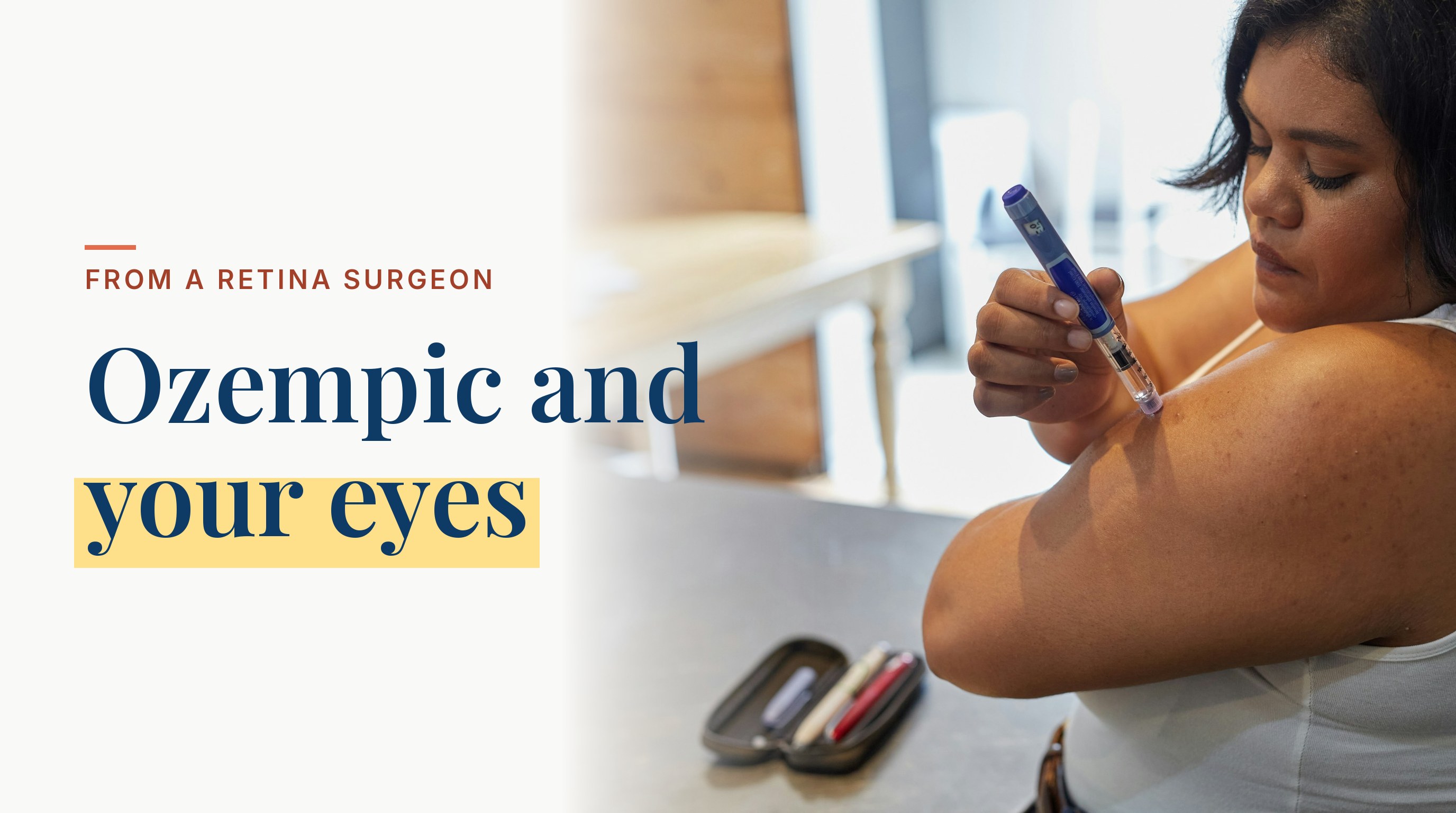
Can Ozempic cause blindness? Large studies link semaglutide, the drug in Ozempic and Wegovy, to about twice the risk of a rare optic nerve stroke called NAION. Because NAION is rare to begin with, that works out to roughly one extra case per 7,000 people taking the drug for a year, and not every study finds the link at all.
I'm a retina surgeon, and since the lawsuits hit the news, this is one of the questions I hear most in clinic. So here's what the research actually shows, in real numbers, plus the eye issue I spend even more time talking about with patients on these drugs.
The short version
The NAION risk is real but rare, and the evidence is mixed. US eye specialists don't recommend that everyone stop their GLP-1 over it. Two things matter most: sudden, painless vision loss means a same-day eye exam, and if you have diabetes, keep up with your dilated eye exams.
What is NAION?
NAION is a stroke of the optic nerve, the cable that carries everything you see from your eye to your brain. The full name is non-arteritic anterior ischemic optic neuropathy. That's a mouthful even for eye doctors, so everyone just says NAION.
The front of the optic nerve doesn't get enough blood flow. It swells, and some of the nerve fibers are permanently damaged.
What it feels like: sudden, painless vision loss, usually in one eye. Some people say the whole eye goes blurry. Others notice the top or bottom half of their vision is dim or missing, often when they wake up.
The hard part is that we don't have a treatment that reliably brings the vision back. Some people improve over weeks to months, but many are left with permanent changes. That's why knowing who's at risk, and getting seen quickly, matters so much.
Who gets NAION?
NAION was around long before GLP-1 drugs. The biggest risk factors are:
Diabetes
High blood pressure
A small, crowded optic nerve (something your eye doctor can see on an exam)
Low blood pressure at night
Sleep apnea
If you snore or wake up tired and you're on a GLP-1, that's one more reason to ask your doctor about a sleep study. I wrote more about that in why a retina surgeon asks about your sleep.
How big is the risk, really?
About double, from a very small starting point. And the evidence is still mixed.
The first signal came in 2024 from Mass Eye and Ear, a Harvard-affiliated hospital. Researchers looked at patients in a neuro-ophthalmology clinic and found a much higher rate of NAION in people on semaglutide. That study got everyone's attention. But it came from one specialty clinic, where the hardest optic nerve cases get sent, so it likely overstated the risk.
Since then, much bigger studies have come in. Here's where they land:
Study | What it found |
|---|---|
2026 meta-analysis of large registry studies, people with type 2 diabetes | About 2x the risk with semaglutide, roughly 1 extra case per 7,000 people per year. The researchers rated their certainty as low. |
European Medicines Agency review, 2025 | Lists NAION as a "very rare" side effect of semaglutide, a category that means up to about 1 in 10,000 people. |
US study of about 120,000 people on semaglutide, 2025 | No increase in NAION. |
Multinational population study, 2025 | No increase in NAION. |
Pooled analysis of 20 randomized trials, 2026 | No increase in optic nerve events. |
Here's how I think about it. "Twice the risk" is a relative risk, and it sounds big. The absolute risk is what actually happens to people.
Picture a sold-out NBA arena, about 20,000 people, all taking semaglutide for a year. If the studies that find a link are right, maybe two or three of them would have an extra NAION because of the drug. That's real, and if it happens to you, it can be life-changing. But it's rare.
What about Mounjaro and Zepbound?
Tirzepatide, the drug in Mounjaro and Zepbound, has less data. One large study grouped it with semaglutide and found a small increase, about 4 in 10,000 versus 2 in 10,000 over two years. Whether tirzepatide on its own carries the same risk is honestly unclear right now.
What about the lawsuits?
As of October 2026, a couple hundred NAION cases have been filed against GLP-1 makers. The FDA says it's evaluating the question, and the US drug labels haven't changed.
Should I stop my GLP-1 because of NAION?
Not on your own, and not because of a headline.
In 2026, the North American Neuro-Ophthalmology Society (NANOS) and the American Academy of Ophthalmology (AAO) published a consensus statement on exactly this question. They don't recommend that everyone stop. For a lot of people, especially those with severe obesity, hard-to-control diabetes or heart disease, stopping can carry more risk than the eye risk does.
If you do get NAION while on semaglutide, this is where the experts disagree:
Europe: the European Medicines Agency says to stop the drug.
United States: NANOS and the AAO call it a shared decision with your doctors, because the risk to the other eye is uncertain and stopping has its own risks.
If you've already had NAION in one eye, or an eye doctor has told you your optic nerves look small, talk with your eye doctor before you start.
Can GLP-1 drugs make diabetic retinopathy worse?
This is the eye risk the headlines are missing, and it's the GLP-1 conversation I have most often as a retina surgeon. Diabetic retinopathy is damage to the small blood vessels in the retina from high blood sugar.
Here's what surprises people. When blood sugar comes down quickly, retinopathy can get worse for a while before it gets better. We've known this for decades. In the landmark DCCT trial of intensive insulin, early worsening happened in about 13% of people on intensive treatment versus about 8% on standard treatment. I still see it in clinic when someone's blood sugar drops fast, whether from starting insulin or another big change.
In the big semaglutide heart trial, SUSTAIN-6, retinopathy complications happened in 3.0% of people on the drug versus 1.8% on placebo. Most of those were people who already had retinopathy and whose blood sugar dropped quickly.
Now the reassuring part. A 2025 review of randomized trials covering about 74,000 people found that, overall, semaglutide neither raised nor lowered the risk of diabetic retinopathy. The early worsening looks temporary, and it usually doesn't lead to permanent vision loss. A large trial called FOCUS is designed to settle the question, with results expected around 2027 or 2028.
Better blood sugar protects your eyes in the long run, so none of this is a reason to avoid the medicine. It is a good reason to keep your eyes in the plan, especially if you already have retinopathy.
Do GLP-1 drugs cause macular degeneration?
Probably not. One 2025 study linked these drugs to wet macular degeneration in older adults with diabetes, but the absolute numbers were tiny: about 2 in 1,000 versus 1 in 1,000 over a few years. Larger studies since then, including one of about 228,000 people, found no increase, and a couple even found a lower risk. I'm watching it, but I'm not changing anything because of it.
Do GLP-1 drugs have any benefits for your eyes?
To be fair to these drugs, they're powerful and they help a lot of people. Better blood sugar, lower weight and better blood pressure compound into better overall health, and your eyes are part of that. Some early research even suggests GLP-1 activity might help protect optic nerve tissue.
None of this is a reason to start or avoid them. It's part of weighing the risks and benefits with your prescribing doctor, and deciding what feels right for you.
Do I need an eye exam before or after starting a GLP-1?
If you have diabetes: yes. You should already be getting a dilated eye exam, usually every year, and starting a GLP-1 is a good moment to make sure you're current. If you already have retinopathy, your eye doctor may want to see you more often while your blood sugar comes down.
If you don't have diabetes: the eye specialists' consensus doesn't recommend a routine exam just to check your NAION risk before starting.
If you've had NAION, or been told your optic nerves look small: get an eye exam before you start.
Everyone: tell your eye doctor you're on a GLP-1, including if you get it through an online clinic or a compounding pharmacy, because it may not show up in your records.
What I'd do if I were on a GLP-1
Know the one symptom. Sudden, painless vision loss in one eye means a same-day eye exam.
Keep up with eye exams if I had diabetes, and tell my eye doctor when I started.
Get checked for sleep apnea if I snored or woke up tired.
Tell my surgeon before any eye surgery. GLP-1 drugs slow how fast your stomach empties, and anesthesiologists have their own guidelines for these drugs around surgery. That can affect the timing of cataract or retina surgery.
Make medication changes with my doctor, not because of a headline.
The free scorecard
Your eyes are one part of a bigger health plan. The Eye Optimization Scorecard is a free guide to the everyday foundations that help protect your eyes, with a few simple ideas to try for each one. It's built to help you protect your Visionspan™, the years your vision works well.
Get the free Eye Optimization Scorecard
Quick answers to common questions
Can Ozempic cause blindness?
It's possible but rare. Large studies link semaglutide to about twice the risk of NAION, an optic nerve stroke, which works out to roughly 1 extra case per 7,000 people per year. Several large studies found no increase at all.
What are the warning signs of NAION?
Sudden, painless vision loss, usually in one eye and often noticed on waking. It can blur the whole eye or the top or bottom half of your vision. Get a same-day eye exam.
Should I stop Ozempic or Wegovy because of the eye risk?
Not on your own. US eye specialists (NANOS and the AAO) don't recommend a blanket stop. Talk with the doctor who prescribed it.
Do Mounjaro or Zepbound cause NAION?
The data on tirzepatide is limited and unclear. One large study grouped it with semaglutide and found a small increase.
Can GLP-1 drugs make diabetic retinopathy worse?
Temporarily, in some people. A fast drop in blood sugar can cause early worsening, mostly in people who already have retinopathy. Overall, trials show no change in long-term retinopathy risk.
Do I need an eye exam before starting a GLP-1?
If you have diabetes, keep up with your yearly dilated exams. If you've had NAION or been told your optic nerves look small, get an exam first. Otherwise, a routine exam just for NAION risk isn't recommended.
References
What the eye specialists and regulators say
1. DeParis SW, Oke I, Gaier ED, et al. Glucagon-like peptide-1 receptor agonists and the risk of non-arteritic anterior ischemic optic neuropathy: a consensus statement by the North American Neuro-Ophthalmology Society and the American Academy of Ophthalmology. Ophthalmology. 2026;133(8):1029-1035. doi:10.1016/j.ophtha.2026.04.008
2. European Medicines Agency. Meeting highlights from the Pharmacovigilance Risk Assessment Committee (PRAC), 2-5 June 2025. ema.europa.eu
3. Medicines and Healthcare products Regulatory Agency. Semaglutide and non-arteritic anterior ischaemic optic neuropathy (NAION). Drug Safety Update. 5 February 2026. gov.uk (PDF)
GLP-1 drugs and NAION: the studies
4. Hathaway JT, Shah MP, Hathaway DB, et al. Risk of nonarteritic anterior ischemic optic neuropathy in patients prescribed semaglutide. JAMA Ophthalmology. 2024;142(8):732-739. doi:10.1001/jamaophthalmol.2024.2296
5. Chrzanowski J, Walicka M, Burzyński J, et al. Semaglutide-associated risk of nonarteritic anterior ischemic optic neuropathy in patients with type 2 diabetes: a systematic review and meta-analysis of observational studies. PLOS Medicine. 2026;23(5):e1005064. doi:10.1371/journal.pmed.1005064
6. Wang L, Volkow ND, Kaelber DC, Xu R. Semaglutide or tirzepatide and optic nerve and visual pathway disorders in type 2 diabetes. JAMA Network Open. 2025;8(8):e2526327. doi:10.1001/jamanetworkopen.2025.26327
7. Abbass NJ, Nahlawi R, Shaia JK, et al. The effect of semaglutide and GLP-1 RAs on risk of nonarteritic anterior ischemic optic neuropathy. American Journal of Ophthalmology. 2025;274:24-31. doi:10.1016/j.ajo.2025.02.025
8. Chou CC, Pan SY, Sheen YJ, et al. Association between semaglutide and nonarteritic anterior ischemic optic neuropathy: a multinational population-based study. Ophthalmology. 2025;132(4):381-388. doi:10.1016/j.ophtha.2024.10.030
9. Li HY, Chan TK, Co Shih K, et al. GLP-1 receptor agonists and risk of optic nerve or vision-threatening events in patients with type 2 diabetes or cardiometabolic diseases: a meta-analysis of randomized controlled trials. Diabetes Care. 2026;49(3):526-535. doi:10.2337/dc25-1929
10. Noh Y, Yin H, Ben Ghezala I, et al. Glucagon-like peptide 1 receptor agonists and risk of nonarteritic anterior ischemic optic neuropathy in patients with type 2 diabetes. Diabetes Care. 2026;49(5):763-771. doi:10.2337/dc25-2577
11. Ueda P. GLP-1 receptor agonists and serious adverse events: evidence, uncertainty and clinical implications. Journal of Internal Medicine. 2026.
NAION basics
12. Biousse V, Newman NJ. Ischemic optic neuropathies. New England Journal of Medicine. 2015;372(25):2428-2436. doi:10.1056/NEJMra1413352
13. Tan JK, Kaw R, Nugawela M, et al. Medical interventions for non-arteritic anterior ischaemic optic neuropathy. Cochrane Database of Systematic Reviews. 2022. doi:10.1002/14651858.CD015516
14. Chatziralli IP, Kazantzis D, Chatzirallis AP, et al. Cardiometabolic factors and risk of non-arteritic anterior ischemic optic neuropathy: a systematic review and meta-analysis. Graefe's Archive for Clinical and Experimental Ophthalmology. 2022;260(5):1445-1456. doi:10.1007/s00417-021-05522-4
Diabetic retinopathy
15. Lim JI, Kim SJ, Bailey ST, et al. Diabetic Retinopathy Preferred Practice Pattern. Ophthalmology. 2025;132(4):P75-P162. doi:10.1016/j.ophtha.2024.12.020
16. Marso SP, Bain SC, Consoli A, et al. Semaglutide and cardiovascular outcomes in patients with type 2 diabetes (SUSTAIN-6). New England Journal of Medicine. 2016;375(19):1834-1844. doi:10.1056/NEJMoa1607141
17. Vilsbøll T, Bain SC, Leiter LA, et al. Semaglutide, reduction in glycated haemoglobin and the risk of diabetic retinopathy. Diabetes, Obesity and Metabolism. 2018;20(4):889-897. doi:10.1111/dom.13172
18. Natividade GR, Spiazzi BF, Baumgarten MW, et al. Ocular adverse events with semaglutide: a systematic review and meta-analysis. JAMA Ophthalmology. 2025;143(9):759-768. doi:10.1001/jamaophthalmol.2025.2489
19. Francisco C, Neves JS, Laiginhas R, Falcão M. Glucagon-like peptide-1 receptor agonists and diabetic retinopathy: a systematic review of diabetic retinopathy outcomes. Graefe's Archive for Clinical and Experimental Ophthalmology. 2026. doi:10.1007/s00417-026-07430-x
20. FOCUS: semaglutide vs placebo in people with type 2 diabetes and diabetic eye disease. ClinicalTrials.gov NCT03811561. clinicaltrials.gov
Macular degeneration
21. Shor R, Mihalache A, Noori A, et al. Glucagon-like peptide-1 receptor agonists and risk of neovascular age-related macular degeneration. JAMA Ophthalmology. 2025;143(7):587-594. doi:10.1001/jamaophthalmol.2025.1455
22. Cai CX, Toy B, Martin B, et al. Semaglutide and neovascular age-related macular degeneration among adults with type 2 diabetes: an OHDSI network study. Ophthalmology. 2026;133(10):1221-1229. doi:10.1016/j.ophtha.2026.05.034
23. Allan KC, Joo JH, Kim S, et al. Glucagon-like peptide-1 receptor agonist impact on chronic ocular disease including age-related macular degeneration. Ophthalmology. 2025;132(7):748-757. doi:10.1016/j.ophtha.2025.01.016
24. Pan SY, Weng CH, Sheen YJ, et al. GLP-1 receptor agonists and age-related macular degeneration risk in diabetes or non-diabetic obesity: a retrospective cohort study. American Journal of Medicine. 2026;139(11):1470-1479. doi:10.1016/j.amjmed.2026.06.023
News
25. NPR. Ongoing lawsuits allege GLP-1s can cause serious harm. But we don't know how often. October 10, 2026. npr.org
Last updated October 19, 2026.
This article is for general educational purposes only and is not medical advice. Reading it does not create a doctor-patient relationship. Always consult your own physician about your specific situation, and don't stop or change a medication without talking to the doctor who prescribed it. If you experience sudden vision loss, flashes, a curtain over your vision, or eye pain, seek care immediately.
Views expressed are my own and do not represent any institution or practice I am affiliated with.
Disclosure: I am the founder of Aetopia Health, which offers the free Eye Optimization Scorecard and the Visionspan™ Foundations guide. I have no financial relationship with any GLP-1 drug maker.